
Apart from excelling in our professional work, there is a pressing need to keep a watch on the finances. Be it a freelancer or an entrepreneur, bookkeeping as a practice is must.
Bookkeeping (n)
the activity or occupation of keeping records of the financial affairs of a business.
In absence of the same, eventually the money will also disappear from your pockets. And this is something we do not want for sure.
As a small business owner, it is difficult to look outside the day-to-day activities. But, it makes proper sense to take a pause and check the financial situation of the business. Doing this we will have an objective look on what’s really happening in the business.
Apart from the metrics of page hits, social shares etc. the other vital metrics for a business are;
- The cash you have available as of now.
- Cash flow projections including projected turnover.
- Debtors (money owed to your business).
- Creditors (money your business owes to others, mainly suppliers).
- Sales tax and payroll liabilities.
- Income and other tax liabilities for future year and upcoming years.
- Equity ratio – seeing whether your equity is building and where your money went.
It is these numbers which will give you a clear true picture you need – no matter if it is good or bad.
OK! Let us sift through the jargon mentioned above, and focus on what needs to be done to get started.
Remember! Knowing your numbers can make you feel like a confident and savvy business owner. So with that good feeling, read on the small bookkeeping tasks you can perform.
Check in on your bank balance.
Your business’ bank account balance is the easiest way to get a quick look at the financial health of your business. Make sure there’s nothing there that looks strange or even fraudulent. Then, if you’re keeping track of your transactions in a bookkeeping system, spreadsheet, or notebook you can use this data to quickly match your transactions and make sure everything reconciles.
Scan or save important receipts & paperwork.
Make an effort to scan any paperwork and save it to a cloud-based storage system so you can reduce paper clutter in your work space. Save important email invoices or receipts as PDFs and save them as well. Thank us later for this.
Summarize your monthly revenue & expenses.
Even if you aren’t using accounting software, you can use a simple spreadsheet or notebook, and just use a calculator to quickly sum your sales for the month. Do the same for your expenses (you can refer to bank account transactions for help with this). The goal is just to become aware of how much you’re really making and spending each month. Keep track of these numbers so you can compare trends and see how you’re doing from month to month. This is how the cash flows in your business.
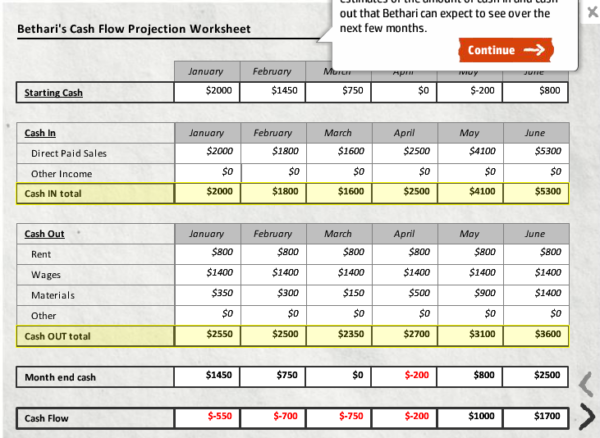
A monthly cash flow example
Calculate your monthly net profit.
Take the total sales (or revenue) and expenses you just calculated and let’s do some simple subtraction! Revenue – expenses = net profit, aka how much you actually made this month. If the number is negative, that’s a net loss. You need this information to grow your business, to set appropriate goals, and to make smart decisions. Ensure to include every expense incurred.
Review your financial performance for the month.
How’d you do this month financially? How’d you do compared to last month or this time last year? If you had a net loss, why? Did you make a large investment in a new website or subscribe to a service? Did you have a lackluster launch that needs some fine-tuning? This is an important step – take your financial, quantitative results and see what helpful qualitative info you can gain from them. If you neglect your numbers, you’re missing out on a whole wealth of info that you can use to take your business to the next level.
Plan ahead for next month.
Set financial goals based on your yearly budget and your past performance. It can be super-motivating to set a sales or revenue goal for the month. Don’t forget to look at your expenses too – do you have any big expenses coming up that you need to plan ahead for? Take the lessons learned from last month and move forward with them. Where can you do better next month? Look at the calendar when planning for the month and make sure to account for any holidays or events coming up.
You CAN take control of your bookkeeping by performing these simple tasks each month/week. This will increase your awareness of the money going in and out of your business, which is the first step to becoming confident about your business. Your
business’ financial info shouldn’t be something that drags you down. It should be something that you can use as a tool for smart decisions to move your business forward.
Here is a good short course on cash flow which will help you gain insight on the term;
We use Wave App for our Accounting purposes, and its been good so far.
Remember! Better bookkeeping, Better decisions, Better business.
Great article. Wisely chosen topic. Simple and easy to follow. Looking forward for your next article. Keep it up. I am sharing this.
Hi Shwetha,
Thanks a ton for the appreciation & the share.
We are also looking forward to seeing you again.
Cheers,